Giac.jl
Bringing Giac computer algebra to Julia with interactive notebooks
Presentation: s-celles.github.io/Giac.jl_juliacon2026 
2026-08-12
Introduction
Sébastien Celles
- 🏫 PRAG (professeur agrégé) at Université de Poitiers (France) ie teaching only position
- 🎓 No research / no PhD - not mathematician but physicist specialising in Electrical Engineering and computer sciences.
- 🐍 Python enthusiast (and many other languages) → Julia convert

📎 Presentation: https://s-celles.github.io/Giac.jl_juliacon2026/
Julia & open-source contributions
- 📖 Technical reviewer of Julia for Data Science (Joshi, A., 2016, Packt Publishing, ISBN 9781785289699)
- …
- 📦 ToonFormat.jl — Token-Oriented Object Notation (registered)
- 🔗 PackageURLs.jl — Package URL (PURL) library, ECMA-427 compatible (registered)
- 📐 JSXGraph.jl — interactive geometry plots (registered)
- 🌐 gRPCServer.jl — gRPC server for Julia (unregistered but in touch with an OSCP for testing)
- 🌐 Nghttp2Wrapper.jl — nghttp2 wrapper for Julia (registered) …
Why CAS? A personal journey
Ongoing project: Symbolic electrical circuit simulator
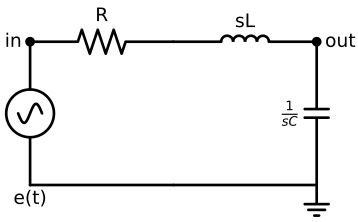
A very basic RLC circuit schematics
Symbolic impedance: \(Z(s) = R + sL + \frac{1}{sC}\)
What do we need from a CAS?
- 🔌 Kirchhoff’s laws → system of symbolic equations
- ⚡ Transfer functions, impedances, Laplace transforms
- 📐 Need: solving, simplification, partial fractions
- 🧮 Modified nodal analysis (MNA) - Kirchhoff’s Current Law (KCL) at each node (except ground)
The gap in Julia’s symbolic ecosystem
Symbolics.jl doesn’t yet support features I need (or at least I haven’t found how to do them):
- ⁉️ Laplace transforms — issue JuliaSymbolics/Symbolics.jl#1770 (open) - PR JuliaSymbolics/Symbolics.jl#1590 merged 2 weeks ago
- ❌ Partial fraction decomposition — JuliaSymbolics/Symbolics.jl#249 (open)
- ❌ Feature completeness vs SymPy — JuliaSymbolics/Symbolics.jl#59 (open)
The solution: Giac
Leverage Giac’s mature CAS (20-30 years of development) via Giac.jl:
- ✅
laplace,ilaplace— Laplace and inverse Laplace transforms - ✅
partfrac— partial fraction decomposition - ✅
solve— algebraic & systems of equations - ✅
desolve— ordinary differential equations - ✅ 2000+ commands available
What is Giac?
Giac is a mature, open-source (GPL licensed) C++ computer algebra system developed by Bernard Parisse at Université Grenoble Alpes.
 🔗
🔗 Giac Powers…
- 🖥️ Xcas - Desktop CAS application
- 📐 GeoGebra - Dynamic mathematics software
- 🔢 HP Prime - Professional calculator
Giac capabilities
- Symbolic algebra & simplification
- Calculus (derivatives, integrals, limits)
- Polynomial arithmetic
- Gröbner bases
- Linear algebra
- Equation solving (algebraic & ODEs)
- And much more…
Giac in one integration benchmark
Important: this is not an overall CAS ranking. Symbolic integration is only one capability among algebraic simplification, equation solving, transforms, linear algebra, and many others.
Independent integration benchmark (Summer 2024): 106,812 integrals, nine systems.
| Rank | CAS | Solved | Rank | CAS | Solved |
|---|---|---|---|---|---|
| 1 | Mathematica | 97.4% | 5 | Giac/Xcas | 57.5% |
| 2 | Rubi | 93.1% | 6 | Reduce | 54.3% |
| 3 | Maple | 83.8% | 7 | MuPAD | 52.8% |
| 4 | FriCAS | 77.2% | 8 | Maxima | 52.5% |
| 9 | SymPy | 42.2% |
- For integration in this test, Giac ranks 5th, ahead of Reduce, MuPAD, Maxima, and SymPy.
- Open question for 2026: should we refresh and extend this benchmark from Julia with Symbolics.jl, Giac.jl, and SymPy.jl—measuring both the CAS engines and their Julia interfaces?
Source: Nasser M. Abbasi, Computer Algebra Independent Integration Tests — Summer 2024
Why Giac.jl?
Previous Julia interfaces to Giac exist:
- By Harald Hofstaetter
- By Bernard Parisse himself
But they have seen limited maintenance and don’t integrate well with:
- Modern Julia ecosystem
- Notebook environments
- Math interchange formats
The Giac.jl ecosystem - Project overview
| Package | Repository | Description |
|---|---|---|
| Giac.jl | github.com/s-celles/Giac.jl | Julia interface to Giac |
| libgiac-julia-wrapper | github.com/s-celles/libgiac-julia-wrapper | C++ wrapper for Julia |
| giac | github.com/s-celles/giac | The native Giac CAS engine - B. Parisse C++ code but with Meson build |
| Yggdrasil | Yggdrasil / GIAC | BinaryBuilder recipe for Giac |
See developer notes at the end of this talk for more details on the architecture and build system.
Core types
| Type | Purpose |
|---|---|
| GiacExpr | Symbolic expression wrapper (wraps C++ gen pointer) |
| GiacMatrix | Matrix operations wrapper |
| GiacContext | Execution context (thread-local) |
Giac.jl features
- 2000+ Giac commands via
invoke_cmd(:cmd, args...)orGiac.Commands - Expression Evaluation: Parse and evaluate mathematical expressions
- Arithmetic: +, -, *, /, ^, unary negation, equality
- Algebra: Factorization, expansion, simplification, solving, GCD
- Calculus: Differentiation, integration, limits, series
- Linear Algebra: Symbolic matrices, determinant, inverse, eigenvalues
Giac.jl features (cont.)
- Laplace/Z-Transform: Signal processing with
laplace,ztrans - Type Conversion: Results to Julia types (Int64, Float64, Rational, BigInt via GMP)
- Symbolics.jl Integration: Bidirectional tree-based conversion (Symbolics 7)
- Tables.jl: Export GiacMatrix to DataFrames, CSV
- LaTeX Support: Automatic rendering in Pluto notebooks (incl. HeldCmd)
- Constants Module: Symbolic
pi,e,iviaGiac.Constants
Giac.jl - basic usage
Command Discovery and Help
Giac provides a vast library of mathematical commands — all accessible from Julia via Giac.Commands and discoverable via search_commands and search_commands_by_description.
# Search for commands by prefix
search_commands("sin")        # ["sin", "sinc", "sinh", ...]

# Search with regex
search_commands(r"^a.*n$")    # Commands starting with 'a' and ending with 'n'

# Search by description (find commands by what they do)
search_commands_by_description("polynomial")  # Commands related to polynomials

# List available categories
list_categories()             # [:trigonometry, :calculus, :algebra, ...]

# Get commands in a category
commands_in_category(:trigonometry)  # ["sin", "cos", "tan", "asin", ...]
commands_in_category(:algebra)       # ["factor", "expand", "simplify", ...]
See https://s-celles.github.io/Giac.jl/dev/command_discovery_help/
Differentiation
Partial derivatives
Integration
Limits
Series
Laplace transforms & partial fractions
Key features for signal processing and circuit analysis:
Solving equations
Solving single equations
Solving equations (cont.)
Systems of equations
Symbolic matrices — GiacMatrix
The MNA matrix from earlier is built this way — entries stay symbolic end-to-end:
Symbolic matrices — GiacMatrix (more constructors)
Two more constructors:
Renders as LaTeX in notebooks (Pluto, KaimonSlate…) . Tables.jl integration → export to DataFrames / CSV.
Type conversion
Scalars
Vectors & components
Command access patterns
Four ways to invoke 2000+ commands:
- String evaluation (prototyping)
- Universal gateway (conflict-free)
- Commands module (explicit import)
- Method syntax (fluent API… but is that a Julian way?)
MCP server — two MCP tools
Two MCP tools exposed:
giac_eval— evaluates any Xcas/Giac expression (~2200 commands reachable through one string). Julia errors returned asCallToolResult(isError=true)→ MCP session stays alive.giac_search— keyword search over the catalog (matrix,laplace, …) with prefix-then-substring fallback.
Philosophy: one eval tool, not 2200. The LLM already knows Xcas syntax — Giac is the execution engine, the LLM is the decider.
MCP in action — register and factor a semiprime
❯ Use the giac-cas MCP server to factor
  632459103267572196107100983820469021721602147490918660274601

● giac-cas → giac_eval(expr:
    "ifactor(632459103267572196107100983820469021721602147490918660274601)")
  → 650655447295098801102272374367 × 972033825117160941379425504503
✻ Cogitated for 7s
Giac.jl vs Symbolics.jl
| Giac.jl | Symbolics.jl | |
|---|---|---|
| Backend | C++ (Giac, some decades of development) | Pure Julia |
| Ecosystem | Standalone CAS | SciML, ModelingToolkit |
| Performance | FFI overhead | Native Julia, code generation |
| License | GPL-3 | MIT |
See also: Groebner.jl — a pure Julia package for Gröbner bases.
Not a competition — different strengths for different use cases.
Where Giac also excels — integer factorisation
Also useful for Capture The Flag (CTF) challenges like Hackropole, FCSC, WeShall…:
Julia’s Primes.jl lacks advanced factorisation — JuliaMath/Primes.jl#159
ifactor in action
A 60-digit semiprime (product of two 30-digit primes) factorised in seconds.
Common format for RSA challenges in CTFs — very difficult with pure Julia packages.
Giac.jl ↔︎ LibPARI.jl
PARI/GP is a specialist CAS for computational number theory:
- integer factorisation
- algebraic number theory
- elliptic curves, modular forms, L-functions
LibPARI.jl is its independent, unofficial Julia wrapper.
GiacLibPARIExt is an optional extension: it auto-loads when both packages are used, with no hard dependency.
Bidirectional contract: values and variable names are preserved, but printed representations may change. Integers, rationals, reals, complex numbers, polynomials, vectors, and matrices can cross; unsupported types raise an explicit error.
Giac.jl & Symbolics.jl: complementary
Use Symbolics.jl for:
- SciML ecosystem integration
- ModelingToolkit workflows
- Native Julia performance
- MIT-licensed projects
Use Giac.jl for:
- “Advanced” symbolic integration
- Complex equation solving
- Mature CAS features (2000+ commands)
- Gröbner bases, ODEs, series
Best approach: Use both thanks to to_symbolics and to_giac functions! Bidirectional conversion supported (and probably some others Julia packages too!).
MathField: visual math input for the web
MathField by Arno Gourdol — a web component for math editing (part of the MathLive project).
- WYSIWYG math editor
- Keyboard & handwriting input
- Outputs MathJSON (not just LaTeX)
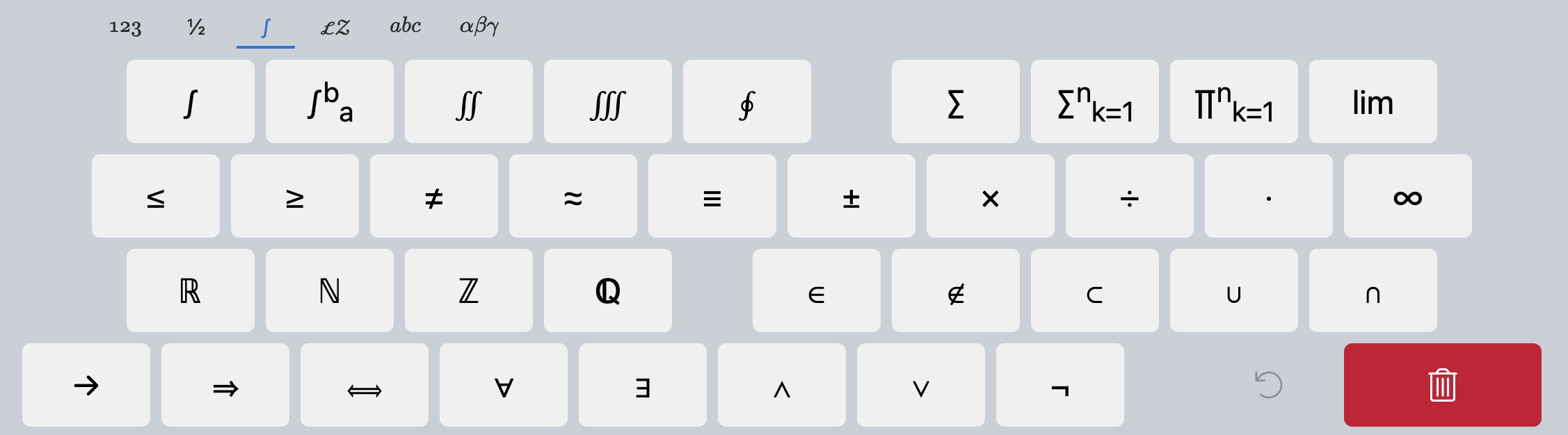
MathField Example
Why MathField matters for Julia
- Natural input for reactives notebooks (Pluto, KaimonSlate…)
- Machine-readable output (MathJSON) — not just a string
- Bidirectional: can render results too
Pipeline: User types math visually → MathJSON → Giac.jl computes → LaTeX display
MathJSON.jl
Parse, manipulate, and serialize MathJSON expressions.
MathJSON is a lightweight JSON-based interchange format from the CortexJS project.
PlutoMathInput.jl
A WYSIWYG math editor widget for Pluto notebooks.
MathJSONComputeEngineBridge.jl
Glue layer: MathJSON visual input → Giac.jl symbolic computation → LaTeX output
%%{init: {'theme': 'base', 'themeVariables': {'primaryColor': '#9558b2', 'primaryTextColor': '#fff', 'primaryBorderColor': '#7C3F9E', 'lineColor': '#389826', 'secondaryColor': '#4063d8', 'background': '#ffffff'}}}%%
flowchart LR
    A["Visual Input<br/>(MathField)"] --> B["MathJSON"]
    B --> C["Julia Symbolic<br/>(Giac.jl)"]
    C --> D["Compute"]
    D --> E["Result"]
    E --> F["Display<br/>(LaTeX)"]
Warning
WIP — better Pluto.jl integration still needed.
Interactive math input
In a Pluto notebook:
using PlutoMathInput
using MathJSON: MathJSONFormat, parse
using MathJSONComputeEngineBridge: evaluate
using Giac, Giac.Commands

# Visual math input — bound to a MathJSON default string
@bind formula MathInput(
    default="[\"Add\",[\"Power\",[\"Sin\",\"x\"],2],[\"Power\",[\"Cos\",\"x\"],2]]",
format=:mathjson)The user types math visually → MathJSON binding updates → the Giac pipeline re-runs instantly.
Reactive differentiation in Pluto.jl
# Cell 1: Setup
using PlutoMathInput
using MathJSON: MathJSONFormat, parse
using MathJSONComputeEngineBridge: evaluate
using Giac, Giac.Commands

# Cell 2: Input — pre-filled with D[x² + 3x − 1, x]
@bind formula MathInput(
    default="[\"D\", [\"Add\",[\"Power\",\"x\",2],[\"Multiply\",3,\"x\"],-1], \"x\"]",
    format=:mathjson, canonicalize=false)

# Cell 3: evaluate (resolves D / Integrate) → Giac → simplify (reactive!)
parse(MathJSONFormat, formula) |> evaluate |> to_giac |> simplify
Each edit of the MathField re-fires the pipeline — evaluate handles D, Integrate, Matrix, …
📓 Notebook: MathJSONComputeEngineBridge.jl/notebooks/example.jl
KaimonSlate — MathField in the cell source
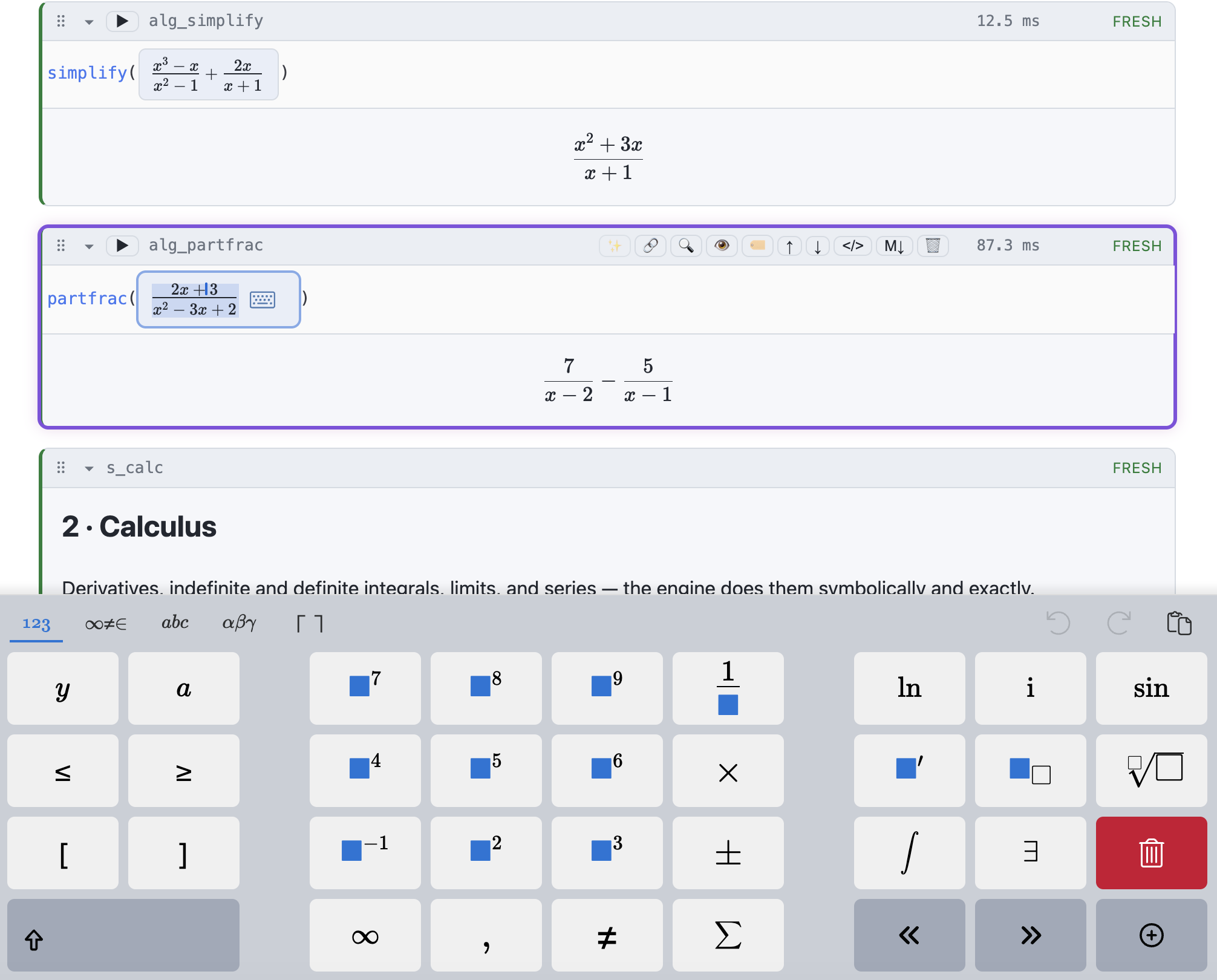
KaimonSlate.jl by Kahli Burke — a reactive Julia notebook where the expression is typed visually, inside the partfrac(...) call.
- Virtual math keyboard
- Results rendered as LaTeX
- Named cells + timing +
FRESHstaleness → reactive re-runs
🔌 GiacSlate.jl — Giac integration for KaimonSlate
KaimonSlate + AI agent
Paired with Kaimon.jl, the notebook is an MCP surface: an LLM agent can read, run and edit cells.
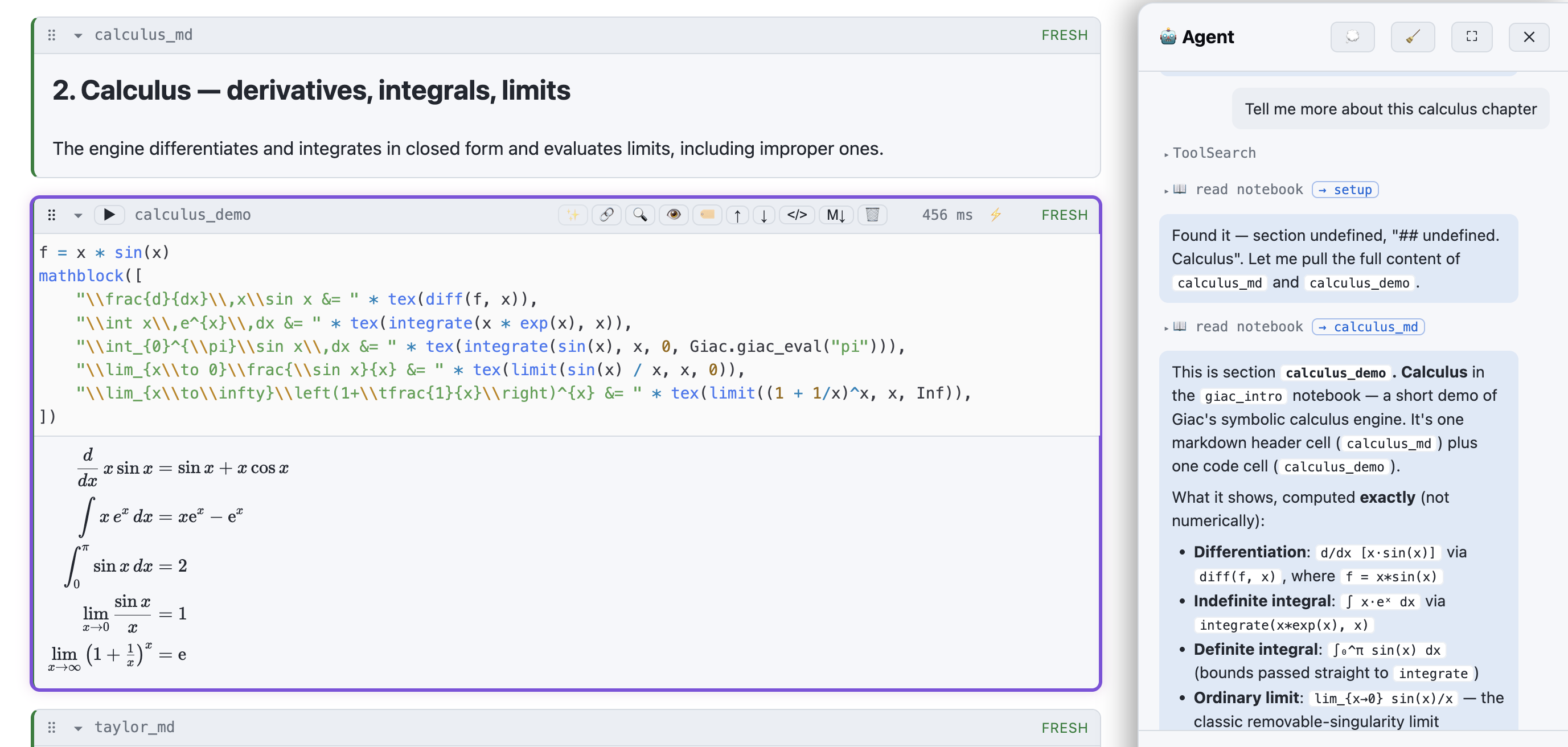
A giac_intro notebook doubles as a live tour — algebra, calculus, Laplace, control systems, symbolic linear algebra — and as teaching material the agent can navigate.
Where gaps remain
Areas where Giac.jl needs work compared to other CAS:
- Tensor calculus — Limited compared to specialized packages
- Assumptions system — Probably less flexible than Sympy
- Plotting — Native plotting in giac but untested in Giac.jl. Converting
GiacExprto Julia function thanks tobuild_functionis possible - Users feedback — Need more real-world use cases to identify pain points and prioritize features
Contributing
All packages are open source and welcome contributions!
| Package | Repository |
|---|---|
| giac | github.com/s-celles/giac (B. Parisse code but with Meson build) |
| libgiac-julia-wrapper | github.com/s-celles/libgiac-julia-wrapper |
| Giac.jl | github.com/s-celles/Giac.jl |
| MathJSON.jl | github.com/s-celles/MathJSON.jl |
| PlutoMathInput.jl | github.com/s-celles/PlutoMathInput.jl |
| MathJSONComputeEngineBridge.jl | github.com/s-celles/MathJSONComputeEngineBridge.jl |
| GiacSlate.jl | github.com/s-celles/GiacSlate.jl |
| CAScad (browser - no Julia) | github.com/s-celles/CAScad |
Acknowledgments
- Bernard Parisse (@parisseb) & Renée De Graeve (Univ. Grenoble Alpes) - Giac/Xcas
- Harald Hofstaetter (@HaraldHofstaetter) - Original Giac.jl implementation
- Arno Gourdol (@arnog) - MathLive, MathJSON, CortexJS Compute Engine
- Kahli Burke (@kahliburke) - KaimonSlate.jl reactive notebook & Kaimon.jl MCP server
Patient reviewers of the Yggdrasil PRs
- Viral B. Shah (@ViralBShah) - Julia co-creator, Yggdrasil guidance
- Mosè Giordano (@giordano) - BinaryBuilder reviewer
- Max Horn (@fingolfin) - BinaryBuilder reviewer
s-celles/Giac.jl contributors
Full circle
Remember the motivation?
Symbolic electrical circuit simulator needing:
- ✅ Laplace transforms →
laplace,ilaplace - ✅ System solving →
solve - ✅ Partial fractions →
partfrac - ✅ Simplification →
simplify
Giac.jl provides all of these!
CASSys.jl — coming next year?
Vision:
- 🎓 Educational tool for Electrical Engineering students
- 🔌 Symbolic Modified Nodal Analysis
- 🔋 Symbolic voltage, current probes
- ⚡ Symbolic transfer functions
- …
Built on:
- Symbolics.jl — native Julia symbolics
- Giac.jl — advanced CAS (Laplace, partfrac) where Symbolics.jl falls short
- ModelingToolkitStandardLibrary.jl / Electrical or DyadLang/ElectricalComponents — component library
Thank you!
Questions?
Giac.jl - Computer Algebra System for Julia

Developer Notes
Six-layer architecture
From user code down to the native C++ library:
- User Code — Scripts, Pluto notebooks, REPL sessions
- Giac.jl API — High-level Julia interface (
@giac_var,Giac.Commands) - Core Types —
GiacExpr,GiacMatrix,GiacContextwrappers
Six-layer architecture
- FFI Layer — CxxWrap.jl bindings to C++ via PIMPL pattern
- FFI (Foreign Function Interface): mechanism for calling C++ code from Julia
- PIMPL (Pointer to IMPLementation): Julia only sees an opaque pointer, never Giac’s C++ internals — this isolates header conflicts between Giac and CxxWrap
- JLL Binaries —
libgiac_julia_jll, pre-built via BinaryBuilder - Giac C++ —
GIAC_jll, the native CAS engine
Six-layer architecture
%%{init: {'theme': 'base', 'themeVariables': {'primaryColor': '#9558b2', 'primaryTextColor': '#fff', 'primaryBorderColor': '#7C3F9E', 'lineColor': '#389826', 'secondaryColor': '#4063d8', 'background': '#ffffff'}}}%%
flowchart LR
    User["👤 User Code<br/>(Scripts, Pluto)"]
    API["📦 Giac.jl API<br/>(@giac_var, Commands)"]
    Core["⚙️ Core Types<br/>(GiacExpr, GiacMatrix)"]
    FFI["🔗 FFI Layer<br/>(CxxWrap.jl)"]
    JLL["📦 JLL Binaries<br/>(libgiac_julia_jll)"]
    Native["🏛️ Giac C++<br/>(GIAC_jll)"]

    User --> API --> Core --> FFI --> JLL --> Native
libgiac-julia-wrapper
CxxWrap.jl bindings exposing Giac to Julia (v0.5.0, GPLv3)
- PIMPL pattern (Pointer to IMPLementation):
GenandGiacContextexpose only an opaque pointer — all C++ internals are hidden behind it - Firewall header: Giac and JLCXX headers conflict, so they are compiled in separate translation units — PIMPL makes this possible
- Meson build system (migrated from CMake)
- Cross-platform: Linux, macOS, Windows
3-tier function dispatch
| Tier | Strategy | Example |
|---|---|---|
| Tier 1 | Direct C++ calls (fastest) | sin, diff, solve, integrate |
| Tier 2 | N-ary generic dispatch by name | Functions with >3 parameters |
| Tier 3 | String evaluation (most flexible) | Most of the 2000+ commands |
libgiac-julia-wrapper types
Two opaque C++ types exposed to Julia:
| Type | Wraps | Role |
|---|---|---|
| Gen | giac::gen |
Universal expression (numbers, symbols, polynomials, …) |
| GiacContext | giac::context |
Evaluation context (thread-local, variables, settings) |
Both use PIMPL — Julia never sees Giac internals, only the opaque pointer.
Development methodology and giving back to the LLM
Spec-Driven Development with AI assistance
This project (Giac.jl) and its ecosystem (both Julia and C++ code) was developed using Spec-Driven Development with AI assistance:
| Tool | Role |
|---|---|
| Claude Opus 4 | AI pair-programmer (Claude Code CLI) |
| GitHub SpecKit | Specification management and task tracking |
The loop closes: an AI agent helped build Giac.jl and now Giac.jl becomes in turn a tool for AI agents thanks to MCP.
Giac itself, the CAS, does not change: the ecosystem around it expands.
MCP server — Giac as a tool for LLMs
Weak-dependency extension GiacMCPExt exposes Giac to any MCP-aware client (Claude Desktop, Claude Code, Cursor) via ModelContextProtocol.jl.
Giac.jl and Symbolics.jl: a bridge for advanced symbolic computation
Symbolics today vs Giac via the bridge — headline trio
As of Symbolics v7.19.0 (April 2026):
| Operation | Symbolics today | Giac via bridge |
|---|---|---|
factor(x^4 − 1) |
MethodError (delegates to Primes.factor) |
(x−1)(x+1)(x²+1) |
solve(cos(x) ~ 1//2) |
float 1.0471… (= Float64 π/3) |
exact ±π/3 |
isolve(21u + 28v = 7) |
rational line u = ⅓ − ⁴⁄₃·v |
integer family (−1+4k, 1−3k) |
Each gets a dedicated example slide next.
Symbolics today vs Giac via the bridge — and more
| Operation | Symbolics today | Giac via bridge |
|---|---|---|
simplify(tan(x) − sin(x)/cos(x)) |
unchanged | 0 |
partfrac(x/(x² − 1)) |
unchanged | ½/(x−1) + ½/(x+1) |
discriminant(ax²+bx+c, x) |
no method on Num |
b² − 4ac |
Pattern: to_giac → Giac.Commands.<op> → to_symbolics. Full set in examples/06_symbolics_bridge.jl.
How the bridge works — two functions
Tree-traversal converters — not a string(expr) round-trip:
Int32-range integers → direct C++ constructorBigInt→ GMP__gmpz_export(binary, no string parsing)π,ℯ,ipreserved as Symbolics constants- Factored forms preserved —
2³·5³is not collapsed to1000
Source: ext/GiacSymbolicsExt.jl.
Bridge example (1/3) — polynomial factorization
Symbolics.factor delegates to Primes.factor and errors out on a polynomial:
Through the bridge:
In flight: PR #1843 adds native Symbolics.factor(f, x) (AI-generated draft, unmerged).
Bridge example (2/3) — exact constants in transcendental solve
Symbolics.symbolic_solve evaluates π/3 as a Float64:
Tracked in #1842
Through the bridge — π/3 stays exact:
Bridge example (3/3) — Diophantine over ℤ vs ℚ
Tradeoff: Symbolics gives the integer-indexed family π/3 + 2kπ but loses the exact constant; Giac gives principal values exactly. For downstream symbolic work (further simplify, integrate, render LaTeX) the exact form is what you want.
Symbolics is also missing half of the solutions (the -π/3 + 2kπ roots).
In flight: PR #1844 ⏳.

JuliaCon 2026 · Giac.jl · Computer Algebra System